The Internet Has Thoughts About Premier Guitar's EarthQuaker Towers Review.
Premier Guitar gave the Towers 4.5 and wrote a cons box that blames the buyer for not knowing synthesizers. Its own verdict says do not take this pedal to a wedding.

Two sides. One page.
Johnny argues the piece. Then he argues against himself. Somebody has to check his work. Read both, then call the winner below.
The take is shown below.
Source
“may not be the kind of jack-of-all-delays/reverb pedal you'd opt to bring to a wedding gig”
What the internet actually said
“I know there's not much love for EQD here but I don't care they are the GOAT for me.”
“I don't say this lightly but this box contains a similar amount of 'magic' as the dispatch master.”
“Loving LFO mode the most right now but all three modes are very distinct and different from each other.”
The Suede Read
James Volpe Rotondi opens his Towers review by naming an audience rather than a genre. If ambient and experimental guitar sounds from the likes of Christian Fennesz, Eivind Aarset, Michael Brook, Stars of the Lid and David Torn are your cup of mushroom tea, he writes, you owe it to yourself to experience this pedal. Score: 4.5 out of 5. Street: 299. Naming five artists in the first sentence is a reviewer telling you exactly who should keep reading, and that is rarer than it sounds.
The pros box is a single sentence doing the work of four. Unique, immersive, rich-sounding cathedral reverbs and micro-echoes, married to a thick low-pass filter, making unexpected and evocative textures that evolve across the stereo field. Sounds from heavenly to haunting. Take it apart and you get the reverb, the filter, the stereo movement and the emotional range, which is a fair description of what a $299 stereo reverberant filter is selling.
Where this review turns strange is the box underneath, and it is worth reading in full rather than in summary. Some users less experienced with controlling the filter cutoffs and LFOs found in synthesizers may find the Towers' super-long decay times and synth-like sonics difficult to reign in.
Look at the subject of that sentence. It is not the pedal. It is the customer, and specifically the customer's synthesizer education. The one slot in the ratings box reserved for what is wrong with the product has been filled with what might be wrong with the buyer.
There is a version of the same point in the body, and there the subject changes back. Play too many dissonant notes, or just too many notes, period, Rotondi warns, and you may find yourself a bit seasick. That is a sentence about what the pedal does to you rather than what you fail to do to it, and it is the more useful of the two.
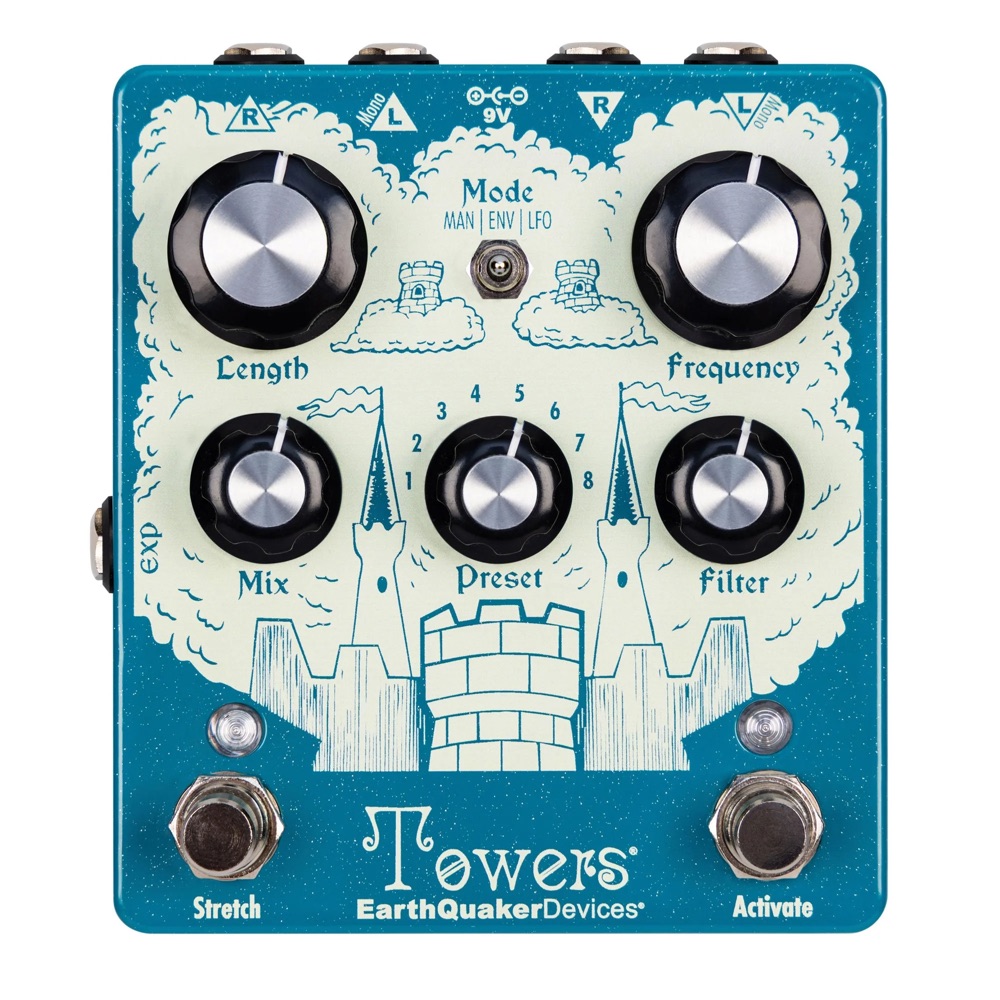
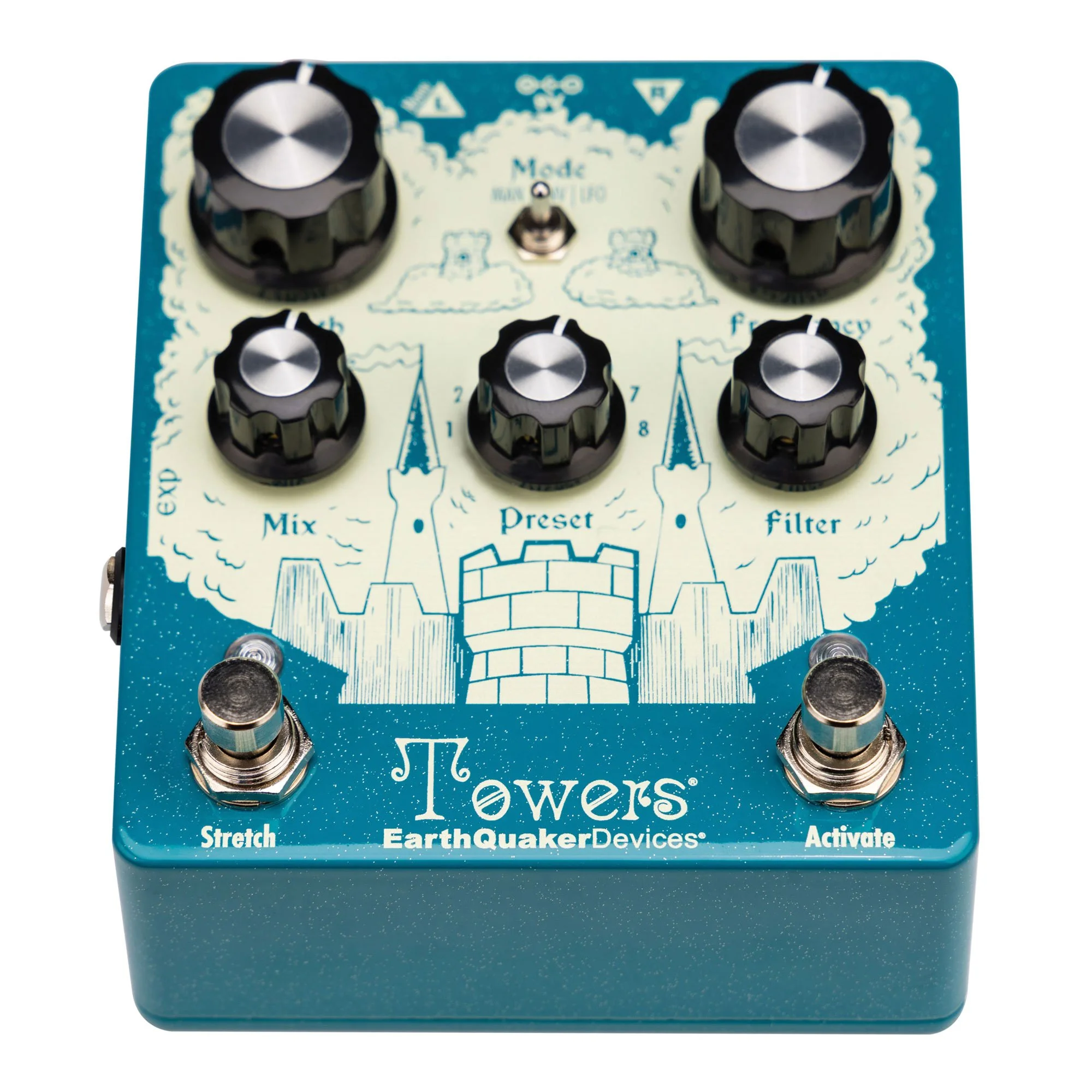
What the pedal is doing explains where the difficulty comes from. The Towers' unique signal path marries an infinitely repeating multi-tap delay with a cathedral-style reverb and a 2-pole resonant low-pass filter, and it runs full stereo inputs and outputs, which Rotondi flags as a first for EarthQuaker. Four knobs govern all of it: reverb length, wet/dry mix, center frequency, and filter cutoff. An infinite multi-tap delay and a resonant filter on the same board is a synthesizer arrangement sold in a guitar enclosure, so a buyer who has never swept a cutoff is not an edge case here. He is the likely customer.
The modes explain why any of this comes up. You play Towers in one of three switchable performance modes. Manual, where you set the filter frequency cutoff on the frequency knob. Envelope, where your playing dynamics drive the sensitivity of the filter response. And LFO. Three routes to the same filter, one of them tied to your hands and one of them running on its own clock.
Rotondi also ranks it inside its own family, which is the comparison most reviews skip. Storied stomps like the excellent Afterneath, Astral Destiny and Transmisser produced similar cascading timbres, he writes, before placing Towers above them as warmer, more musical and widely usable.
Then his verdict qualifies that last word. Towers may not be the kind of jack-of-all-delays/reverb pedal you'd opt to bring to a wedding gig, he concludes, but it more than makes up for that with its almost painterly set of micro-echoes, filter cutoff sweeps, low-end LFO churn and surprisingly warm ambiences. Widely usable and not for the wedding gig, in the same review, about the same pedal.
Set the cons box against the opening paragraph and the two do not point at the same person. The review begins by addressing anybody who listens to Fennesz, Aarset, Brook, Stars of the Lid and Torn, which is an audience with a long history of exactly the filter sweeps and long decays in question. Then the ratings box warns that buyers unfamiliar with synthesizer controls may struggle. One of those two readers was invited in. The other one got the caution.
Over on The Gear Forum, a thread from 5 March had beaten him to the pedal by seven weeks, and its author had bought two. The opener is candid about the room: he knows EQD does not have the most fans there and does not care, calling the company the GOAT before getting to what the thing does.
What it does, according to somebody who paid and took it home, is close to the highest compliment available in that shop. I don't say this lightly, he writes, but this box contains a similar amount of magic as the dispatch master. On the modes he is precise, reporting all three as very distinct and different from each other, with LFO mode his favourite right now.
Which is the detail worth holding. LFO is the mode the magazine's cons box singles out as the one that trips up anybody who has not spent time with synthesizer filters, and it is the mode the owner reaches for first.
Press was right. The sounds Rotondi describes are the sounds the buyer found, down to the stereo movement and the long decays, and the review is honest enough to warn you about seasickness and wedding gigs in its own text. The failure is one line of typing. Given one box to say what is wrong with a $299 pedal, the magazine wrote about the customer instead.
Spotted something the press fluffed? info@suedeai.ai
The counter, argued by Johnny Suede
An enthusiast who already owned two agreeing with a rave is the weakest receipt in the column's drawer, and prosecuting a magazine over the grammar of one cons bullet is a copy-desk complaint with a press badge on.
The confirmation offered here is a forum poster who bought two Towers before the review landed, opens by acknowledging his brand loyalty is unfashionable, calls the company the GOAT, and proceeds to enjoy his purchase. That is the single most predictable document in gear discourse: the early-adopting superfan liking the thing he pre-committed to. The column's own methodology pages teach that this exact receipt, the honeymoon rave from a self-selected believer, is noise. When noise agrees with the press, apparently it graduates to signal.
Then there is the actual charge, which is that a cons bullet has the wrong grammatical subject. Read what it says rather than how it parses: super-long decay times and synth-like sonics are hard to reign in unless you have driven filter cutoffs and LFOs before. That is a warning about the pedal, aimed at the exact buyer most likely to be surprised, and it is more specific than the boilerplate most cons boxes carry. Meanwhile the review's genuinely checkable comparative claim, that Towers beats the Afterneath, Astral Destiny and Transmisser on warmth and usability, went untouched by everyone here. One superfan who owns two of these was not asked whether he still owns an Afterneath.
Here is the audit that was available: Towers against the Afterneath it descends from, against a Fathom at street price, level-matched, with the receipts from month-three owners on whether the novel features survive the honeymoon. Nobody ran it, upstairs or down. Press was right is a conclusion this desk is entitled to reach about EQD, a company whose consistency this masthead documents at length. It is not entitled to reach it on one superfan and a slogan, and the shortcut is the story.