The Internet Has Thoughts About Premier Guitar's EHX Bass Big Muff Pi 2 Review.
Premier Guitar scored the bass fuzz 4.6 and spent its entire cons box on a joke. That leaves a review with no stated fault at all.
Two sides. One page.
Johnny argues the piece. Then he argues against himself. Somebody has to check his work. Read both, then call the winner below.
The take is shown below.
Source
“Your guitar player will be jealous.”
What the internet actually said
“This pedal does exactly what it's designed to do, nothing more, nothing less.”
Sweetwater · g.c.
“I haven't performed a shoot-out, yet. But, the Bass Big Muff Pi 2 stood out immediately.”
“It seems like EHX is playing catch up and trying to roll out the mods other builders have added to the Muff circuit to make it more usable.”
Seymour Duncan Forum · s.
The Suede Read
Steve Cook scored the Electro-Harmonix Bass Big Muff Pi 2 a 4.6 out of 5 at a street price of 122, and the sentence everybody quotes from that review is: your guitar player will be jealous. Worth knowing where it sits. It is not the verdict. It is the entire contents of the cons box.
Read that again with the ratings grid in front of you. Pros: compact, effective, and fun. Cons: your guitar player will be jealous. The one slot in the whole apparatus reserved for telling a shopper what is wrong with a product has been used to tell them that somebody else will envy it. Whatever else that is, it is not a fault, and a 4.6 with no stated fault is a review that has quietly stopped grading.
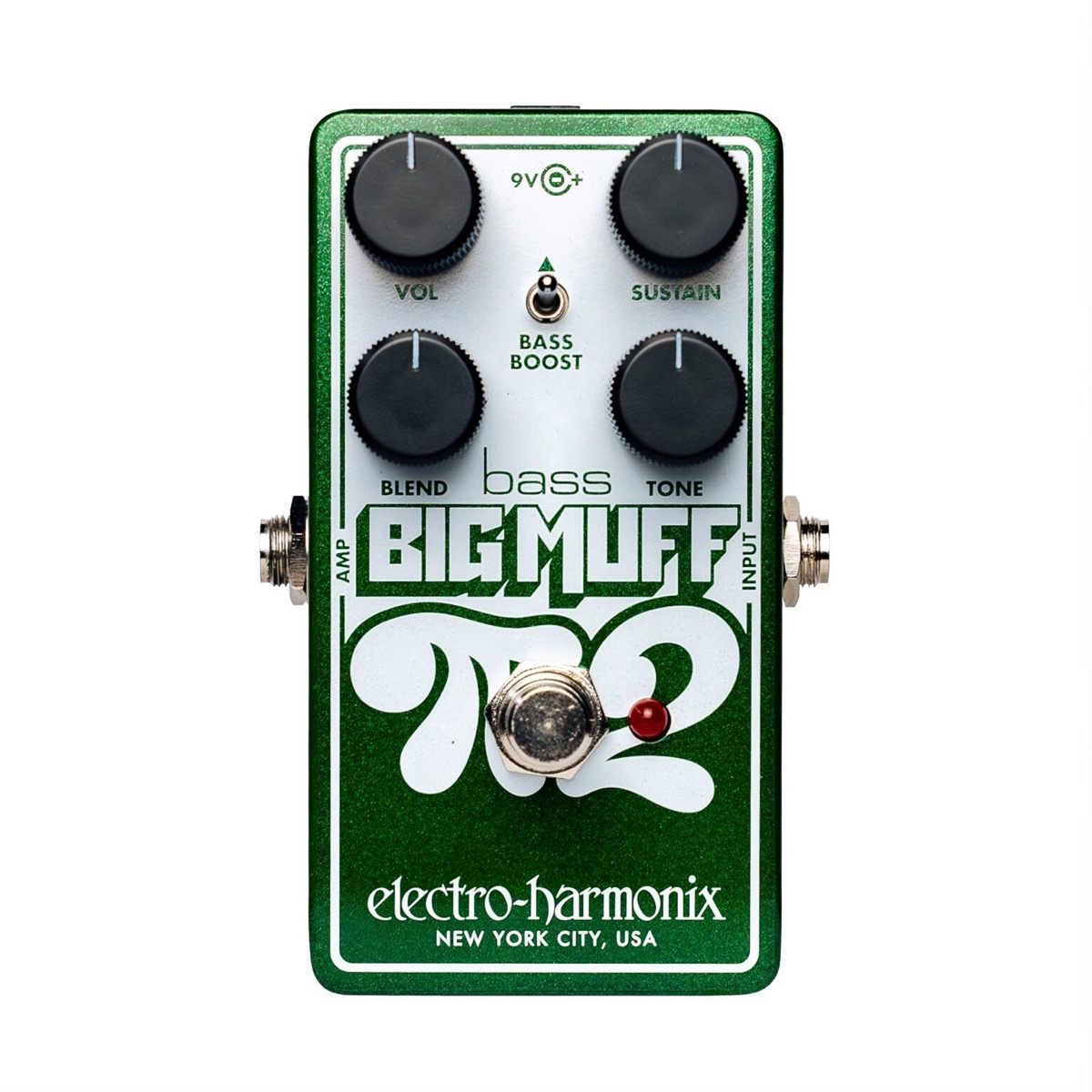
The rest of the piece is more substantial than its furniture suggests, which is the frustrating part. Cook explains the architecture rather than gesturing at it: dual op-amps, which give the Bass Big Muff Pi 2 its name, grind out subtle to aggressive tones, and a bass boost switch summons more low end when the fuzz overpowers the bass foundation. That last clause names a real failure mode of fuzz on bass and then names the control that addresses it.
He is best on the blend knob, and it is the feature that actually distinguishes the pedal. The blend makes the Bass Big Muff Pi 2 even more flexible, he writes, opening up tonal possibilities a conventional Big Muff cannot, enabling you to summon just the right amount of grunt and filth, and again, tame the fuzz when you need a more naked bass tone.
On sound he is brief and unhedged. The tones on the Bass Big Muff Pi 2 are fantastic. Tone and sustain controls also help the BBMP 2 bloom to straight up doom. And he places the pedal in its family: it has regal lineage, rooted in a fuzz that many bass players consider the best for their particular line of work.
Look for a reservation anywhere in the piece and there is not one. Not a hedge about the enclosure, not a note about the switch, not a comparison where the pedal comes second, not a caution about who should skip it. The body is uniformly warm and the cons box is a punchline, which means the 4.6 is the only place in the entire document where anything less than full marks is recorded, and 4.6 does not say why.
So there are checkable claims in the body. A blend control that does something a standard Muff cannot. Twin op-amps. A bass boost switch with a stated purpose. Not one of them reached the boxes anybody skims, and the box that could have carried a caveat carried a punchline instead.
Two people have written the pedal up on Sweetwater, where it lists at $122 with volume, tone, sustain, blend and bass boost across the front. Both are calibrated in a way the review is not.
The first is a sentence the magazine could have written and did not. This pedal does exactly what it's designed to do, nothing more, nothing less. Take it as praise, because that is how it is meant, but notice the ceiling built into it. An owner drawing a boundary around a fuzz box has told a shopper something that a 4.6 with a punchline in the cons slot never gets around to.
Its companion is careful in the other direction. I haven't performed a shoot-out, yet, its author writes, but the Bass Big Muff Pi 2 stood out immediately. He flags the limit of his own testing in the same breath as his verdict, which is a discipline the review skipped entirely. Between them the two of them confirm the pedal does its job and does it noticeably, which is the substance of what Cook claimed, and neither disputes a word of it.
For the argument about where the design came from, the useful room is elsewhere, and it needs labelling before it can be used. The Seymour Duncan Forum thread on the Big Muff Pi 2 is about the guitar model rather than the bass version under review. Nobody in it is holding this pedal. What it is good on is the circuit underneath both.
The member who opens it likes the change for the reason the whole line has been criticised for years, saying it seems to have all the regular Big Muff goodness but a little more mid-range, which has always been his complaint about the regular Big Muff. A Big Muff with usable mids is the modification the boutique world has sold for two decades, arriving from the factory.
Another poster puts the same observation far less warmly, and his is the sharpest sentence anywhere in this story. It seems like EHX is playing catch up and trying to roll out the mods other builders have added to the Muff circuit to make it more usable.
He is not alone in it either. The recommendations across that thread keep pointing away from EHX and toward the small builders who have sold mid-restored Muffs for years, which is the commercial fact under the compliment. A Big Muff with mids used to be a boutique purchase. Now it is a stock item, and one member who has never found a fuzz that he liked allows that this one sounds pretty good.
Press was right. Both owners of the actual pedal report it working, neither contradicts a claim in the review, and the blend, the dual op-amps, the bass boost switch and the restored mids all describe something people recognise once they plug in. The only real criticism anywhere is about who invented the improvements rather than whether they function. A $122 fuzz with a blend knob and a bass boost switch, doing what modders charged for. The cons box had one job.
Spotted something the press fluffed? info@suedeai.ai
The counter, argued by Johnny Suede
A joke in a cons box is a house style, not a scandal, and two retailer reviews plus a thread about a different pedal is not the weight of evidence a verdict needs.
Count the owner record honestly. Two reviews on the storefront of the shop that sold the pedal, one of which opens by admitting its author has not compared it to anything. Then a forum thread about the GUITAR Big Muff Pi 2: different enclosure, different voicing, different customer, no blend knob anywhere in it, nobody holding the product under review. The column labels that second part correctly, to its credit, and then leans on it for the only critical sentence in the whole piece. Strip out the pedal nobody in the thread owns and the dissent evaporates, leaving two satisfied buyers on a retail page. That is a launch-week snapshot, not a finding.
Then the charge itself, which is that a cons box contains a joke. Premier Guitar has printed one-line ratings furniture for years and everybody, including this desk, reads the body for the substance. The body here names an architecture, a failure mode and the control that fixes it, all of which the column quotes approvingly before docking the magazine for its typography. If the standard is that a cons box must contain a fault, say so as a standing rule and apply it to every review on the masthead. Applying it to one 4.6 about a $122 fuzz, and calling the result a review that quietly stopped grading, is a rule invented at the moment it was needed.
EHX gets the benefit of every doubt in this building, a subsidy I have billed elsewhere and will keep billing. The Bass Big Muff Pi 2 may be excellent. The way to know is the way this column was founded to know: month-three bass-forum threads, level-matched against the standard Muff and the original bass model, blend engaged and bypassed. None of that appears. What appears is a quotable verdict about jealousy, endorsed by a desk that was, in the moment, feeling some.