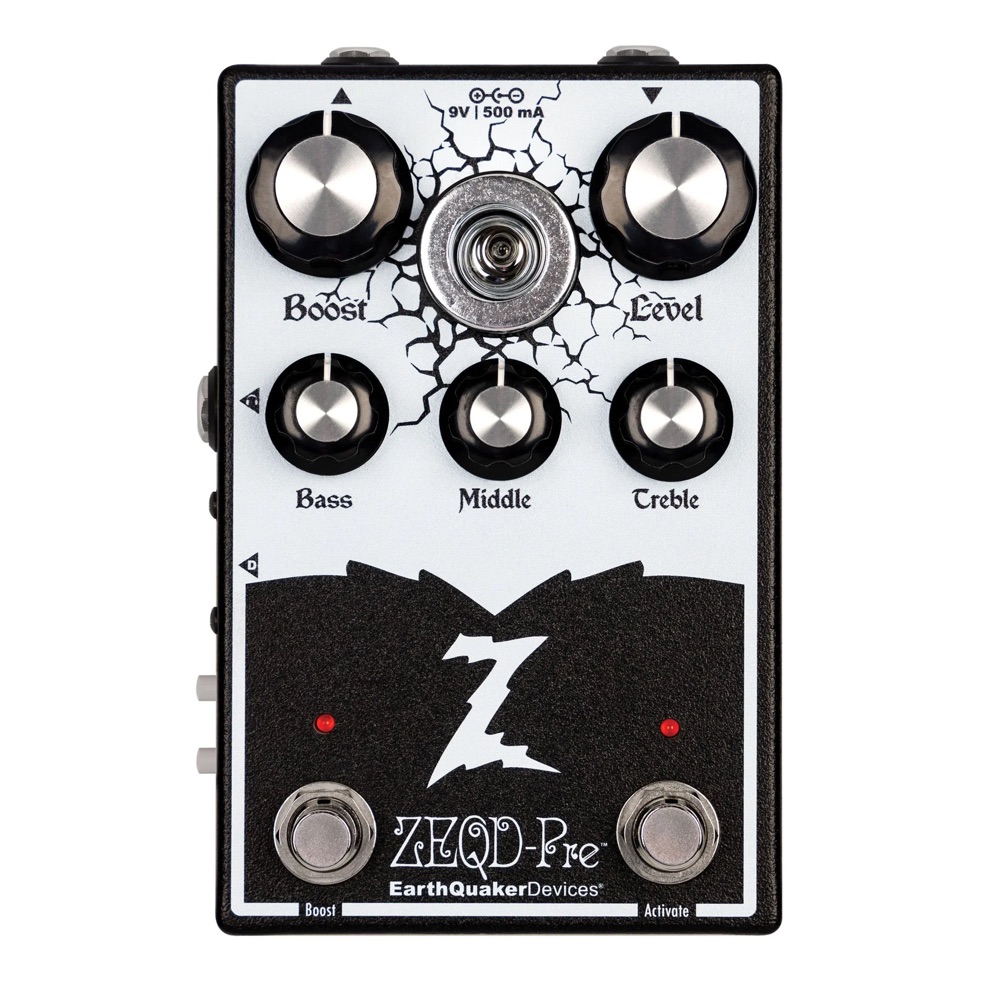
The Internet Has Thoughts About Premier Guitar's EarthQuaker ZEQD-Pre Review.
Premier Guitar scored the Dr. Z collab 4.5 and buried its one scope warning in a subordinate clause. A customer made it an exclamation. A rival masthead made it a cons bullet.

Two sides. One page.
Johnny argues the piece. Then he argues against himself. Somebody has to check his work. Read both, then call the winner below.
The take is shown below.
Source
“In direct-to-DAW situations, the ZEQD-Pre is warm, alive, and sounds, well, a lot like a real amp.”
What the internet actually said
What the other mastheads said
MusicRadar · 4.5/5 · Feb 2, 2026
“May be too clean for some.”
The Suede Read
Charles Saufley scored the EarthQuaker and Dr. Z ZEQD-Pre 4.5 out of 5 and put the case in one line. In direct-to-DAW situations, the ZEQD-Pre is warm, alive, and sounds, well, a lot like a real amp. Street price is $399. The subtitle promises a simple, elegant EF86-driven preamp and passive EQ that make tube amps and digital modelers come alive.
Three claims fill the pros box, and all three are about where the box sits rather than how it sounds. It excels in front of a tube amp or digital modeler or DAW. The EF86 adds richness and dynamics. And it is a great solution in the absence of backline. That last one is a working musician's pro rather than a tone chaser's, and it is the reason this pedal exists.
Saufley is good on why the tube is the story. Use of the EF86 in a preamp is not common, he notes, at least relative to the ubiquitous 12AX7. He is specific about the effect on everything plugged in front of it: the ZEQD-Pre makes distortion and fuzz units sound like their real selves. On the cabinet simulation he is careful in a way that reads as honest, allowing that even without a simulated power amp, the cab sim makes rigs sound great through flat response monitors.
The cons box is one sentence, and it opens by apologising. Yes, the boost might be just about perfect, but it would be cool to be able to use the EQ with it.
Read that twice. A limitation is being smuggled in behind a compliment, and the mechanism underneath it appears only in the body, in five flat words. Switching on the boost disengages the EQ. On a $399 preamp built around a passive three-band EQ and a boost, you get one or the other, and the box that exists to tell shoppers such things phrases it as a wish.
A second limitation is easier to miss because it arrives dressed as praise. The boost is not a high-gain affair, Saufley writes, but it adds weight and excites overtones that might otherwise lay dormant at low volume. The first half of that sentence is a scope warning. The second half is a compliment. They share a comma, and only one of them is doing work for somebody deciding whether to spend the money.
Both owner reviews on Reverb went up before the review ran, in mid and late January. Buyers got there roughly two months ahead of the magazine, which is ordinary and almost never acknowledged in print.
They also broadly agree with it. One says it makes all your fuzz and dirt sound better hitting the amp, which is Saufley's own claim about distortion and fuzz sounding like their real selves, reached independently and phrased better. The other takes the scope warning and promotes it from subordinate clause to headline. If you want high gain, this ain't it.
Now the useful comparison, because a rival masthead reviewed the same pedal seven weeks earlier. MusicRadar also landed on four and a half stars, at £399, and its cons box carries two entries. The boost can be a little bass-heavy. And, in five words a shopper cannot miss: may be too clean for some.
MusicRadar also builds its headline on the same component Saufley singles out. The EF86 tube is often described as hi-fi, its title runs, and honestly, that's the perfect way to describe what's coming out of this thing. Hi-fi is a compliment and a boundary in the same word, and putting it in the headline is a third way of doing the job.
Four pros sit in that rival box, and they describe the same pedal in almost the same terms Saufley reached for: a versatile I/O arrangement, a massive amount of headroom, a convincing all-analog cab sim, and the observation that it can really take pedals well. Saufley said the cab sim makes rigs sound great through flat response monitors and that the pedal makes distortion and fuzz units sound like their real selves. Two reviewers, two countries, one conclusion, and identical scores.
Which is what makes the filing difference the only thing left to talk about. Massive amount of headroom and may be too clean for some are the same measurement written twice, once as a pro and once as a con. MusicRadar chose to write it both ways. Premier Guitar wrote it once, as a compliment, with the warning attached by comma.
Three documents, one finding, three filing systems. Premier Guitar put it in a subordinate clause in paragraph six. MusicRadar put it in a box. A customer put it in an exclamation.
Press was right. Every positive claim Saufley makes survives contact with the people who bought the thing, and the warning a shopper needs is genuinely in his review, which is more than a lot of coverage manages. What separates him from the rival masthead and from the man on Reverb is not what he knew. It is where he put it. A $399 preamp, one EF86, a passive three-band EQ, and a boost that switches the EQ off when you step on it.
Spotted something the press fluffed? info@suedeai.ai
The counter, argued by Johnny Suede
Two five-star reviews is not a jury, and 'the owners posted first' is a fact about retail timing, not a finding about the press.
The post's own headline observation collapses when you look at it. Owner reviews predate the magazine review because the pedal went on sale before the magazine finished testing it, which is how every product launch has ever worked. Presenting that as something the press failed to acknowledge dresses up a shipping calendar as a scandal. Nobody at Premier Guitar claimed to have gotten there first, and no reader thinks a March review means the pedal appeared in March.
On substance the column concedes the whole argument and then charges a fee anyway. It admits Premier Guitar never claimed high gain. It admits the owners agree with the review. It admits the review's one stated reservation was a real interface limitation, honestly disclosed. It now admits the scope warning is printed in the review it is auditing. Having granted all of that, the complaint shrinks to typesetting: the right information reached the reader in a sentence rather than a bullet. That is an argument about layout dressed as an argument about honesty.
And two reviews is two reviews. Both five stars, both from a single retailer's product page, one of them by a man cheerfully narrating his way through two amps in a row. I'm glad they're happy. It is not a sample that can convict or acquit anybody, and a column built on receipts should be the first to say so instead of banking a press-was-right on the strength of a sample size it would mock if a magazine cited it.