The Internet Has Thoughts About Guitar Player's Strymon BigSky MX Review.
Guitar Player's cons box for the $679 pedal reads: nothing, but the price may deter some users. Sixteen owner ratings later, the tag is still the only thing anybody is angry about.
Two sides. One page.
Johnny argues the piece. Then he argues against himself. Somebody has to check his work. Read both, then call the winner below.
The take is shown below.
Source
“the MX is a must-try contender that will satisfy your ambience requirements regardless of your musical style”
What the internet actually said
“The only downsides I see with this pedal is the third switch (infinite) which is less useful than a bank browsing one or a third effect in the bank.”
Thomann · t.v.
“Sounds so good it will bring tears to your eyes. Strymon is the Ferrari of effects pedals.”
Long & McQuade · d.d.
“It is ridiculous that a 10-year old reverb, costing half the price, is still beating this thing.”
Thomann · 0.
The Suede Read
Guitar Player's cons box for the Strymon BigSky MX contains one line, and the line is a shrug: nothing, but the price may deter some users. The price is $679. Christopher Scapelliti does not hedge anywhere else either, writing that the MX will be replacing the original BigSky as his go-to reverb pedal and calling it a must-try contender that will satisfy your ambience requirements regardless of your musical style.
Four entries fill the pros box, and they track the upgrade story instead of restating the headline: the three-dimensional quality of the reverbs, new algorithms with greater realism and depth, two reverbs running at once, and an impulse machine that loads your own IRs. The last of those is the capability Strymon had not shipped before, and the review treats it as the thing that completes the picture.
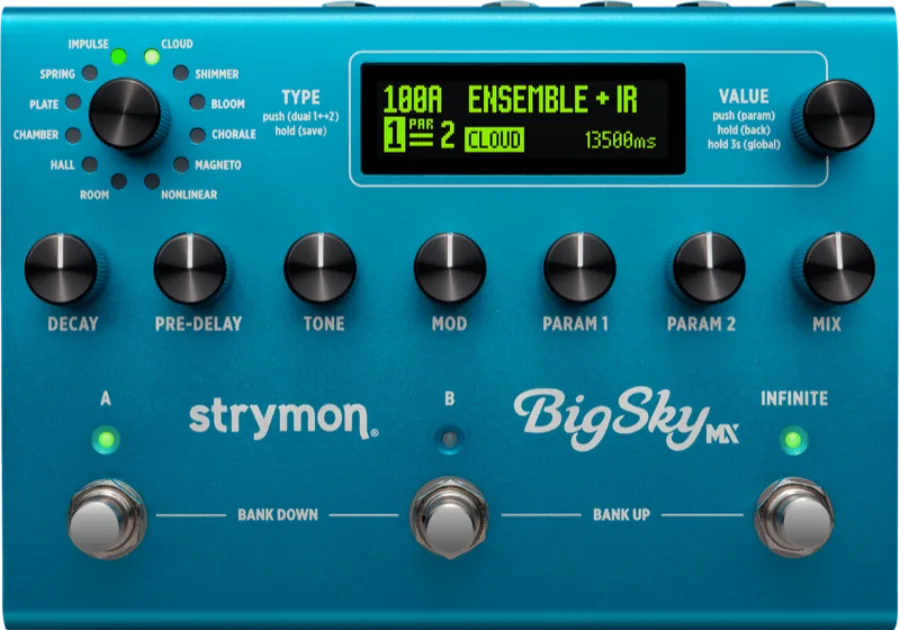
Spec sheet backs the ambition. Twelve reverb machines, running from room, hall, plate and spring out through bloom, cloud, chorale, shimmer, magneto and nonlinear. Twenty-two impulse responses loaded at the factory, covering vintage and modern gear as well as acoustic spaces. Stereo in and out, USB-C, expression and MIDI in both directions, a free librarian for Mac and PC to organise presets and load IRs, built in the USA, the whole thing inside five inches by seven.
Two claims in the body do the persuading. On whether the upgrade is real, Scapelliti sets his own original BigSky against the MX and reports there is no comparison, hearing improved detail, sonic nuance and a sense of being within an actual physical space. On the feature Strymon leads with, the ability to use two reverbs in series or parallel is a powerful feature that opens up a host of sound design opportunities. Storage is sized for the ambition too: a hundred factory presets, two hundred user slots, all three hundred overwritable.
Which makes an empty cons box worth testing, because the body is not as empty as the summary.
Start with the new algorithms and the detail they buy. Scapelliti writes that you may not get the full benefit of them if you play onstage and not in the studio. That is a substantial thing to say about a product built in stompbox format with three footswitches on the front, and it never became a bullet. A second caveat, also unbulleted, has an edge on it. Undoubtedly some players may find the original algorithms more to their liking or prefer their less-detailed sound, he writes. A reviewer conceding that the previous generation might suit you better, inside a review whose cons box says nothing, is a review being more honest than its own furniture.
Over on Long & McQuade the enthusiasm is uncomplicated. One buyer says it sounds so good it will bring tears to your eyes and calls Strymon the Ferrari of effects pedals, which handles the sound and the invoice in a single sentence.
Thomann is where the numbers live. Sixteen ratings, an average of 4.8, and a distribution with a hole in it: fifteen at five stars, one at two, nothing at four, three or one. Two of those sixteen buyers wrote anything.
The five-star write-up is headlined My best guitar pedal ever, and then it does something the magazine did not. Its author names a fault. The only downsides I see with this pedal is the third switch (infinite) which is less useful than a bank browsing one or a third effect in the bank. That is a delighted owner asking for a footswitch to be reassigned. Small point, genuine one, and Guitar Player had the same three switches under its foot and listed nothing.
The two-star is headlined Way overpriced with little innovation and much hype, and it goes at the premise rather than the execution. This pedal is 90% the old dated algorithms packaged differently with a premium price tag, its author writes, before landing the line that gives the whole dissent its shape: it is ridiculous that a 10-year old reverb, costing half the price, is still beating this thing.
Notice what that argument is about. Not whether the reverbs sound good. Whether they sound six hundred and seventy-nine dollars of good, measured against a decade-old box at half the money.
A version of that complaint is already sitting in the review, and the two are worth keeping apart rather than merging. Scapelliti says some listeners will prefer the older algorithms. The dissenter says the new pedal largely is the older algorithms. Those are different claims, and only the first comes from somebody who had both units in front of him. They press on the same nerve, though, and the magazine pressed first.
Guitar Player's closing line is careful about who it is for. The MX is a worth-the-money upgrade for BigSky users and a must-try pedal for any guitarist seeking the highest-quality reverbs in a stompbox format. Both halves of that are conditional. Neither promises the pedal is worth $679 to somebody who already has a reverb they like, which is the buyer the two-star review was written by.
Press was right. Every claim about how the MX sounds survived contact with sixteen buyers, and the one person who came to fight never fought about the sound. He fought about the tag, which is the single item Guitar Player put in its cons box. The two body caveats deserved bullets and did not get them. Neither one contradicts the verdict. The pedal does what the review said it does, and costs what the review said it costs.
Spotted something the press fluffed? info@suedeai.ai
The counter, argued by Johnny Suede
Fifteen five-star reviews from $679 early adopters is the exact honeymoon distribution the Fluff Index warns about, and the house's own mid-year list already called this pedal over-praised. Both verdicts cannot stand.
This masthead has now published two rulings on the BigSky MX. Upstairs, the mid-year fluff list ranks it the single most over-praised pedal of the year, a $679 spec bump whose honest new feature, two simultaneous reverbs, serves approximately the people who post board photos professionally. Down here, the receipts desk reads the same coverage, pulls the same price, and stamps press was right. One building, one pedal, two opposite verdicts, zero cross-references. I am not asking the house to agree with itself. I am asking it to notice, in print, that it does not, because a publication that runs contradictory verdicts without flagging them is doing the thing it audits the glossies for: printing whatever the day's format demands.
Now the receipts themselves. Fifteen five-star reviews and one two-star on Thomann is presented as consensus. Consider who files a review in the launch window of a $679 reverb: buyers who pre-ordered the flagship, self-selected believers with maximum post-purchase investment, reviewing inside the honeymoon. That distribution, near-unanimous raves with a lone dissent, is precisely the shape this column's founding essays teach readers to distrust, the unused bottom half of the scale, the month-six silence. The Fluff Index method says wait ninety days and read the firmware threads. This post read the wedding register and called it a marriage study.
The tears-to-your-eyes, Ferrari-of-pedals quote the post savors is the tell. That is not an audit surviving contact with owners. That is enthusiasm quoting enthusiasm, and the desk that built its name setting launch copy against month-six reality just set launch copy against week-two applause and banked the agreement. The MX may earn the crown; Strymon usually does. Check back at month six, run the used-price rule from the house's own playbook, and print the follow-up either way. Until then this verdict is a deposit, not a finding.