
Electro-Harmonix: the best and worst of the weirdest catalog in pedals.
Mike Matthews has been shipping strange ideas from New York since 1968, and the catalog now runs to hundreds of boxes. Here is what to keep and what to leave on the wall.
Mike Matthews started Electro-Harmonix in 1968 with the LPB-1, a booster the size of a deck of cards that plugged straight into the front of your amp. Fifty-eight years later the catalog runs to hundreds of boxes: four competing dynasties of Big Muff, an octave engine that fakes a Hammond, a pedal that impersonates a sitar, a vocoder, a talk box, and the vacuum tubes inside the amp you plug all of it into. No other pedal company has a catalog like this because no other pedal company would allow it.
That is the thing to understand about EHX. Boutique builders sand one idea for two years and ship the safe version. Matthews ships the idea. The misses go into the catalog right next to the masterpieces, same silkscreen, same font, and sorting them is your problem. This list is me doing that problem for you. Street prices as of this writing, and every pedal judged against what you can buy today, not against what it meant in 1976.
Column · The best
The 5 that earn their slot.
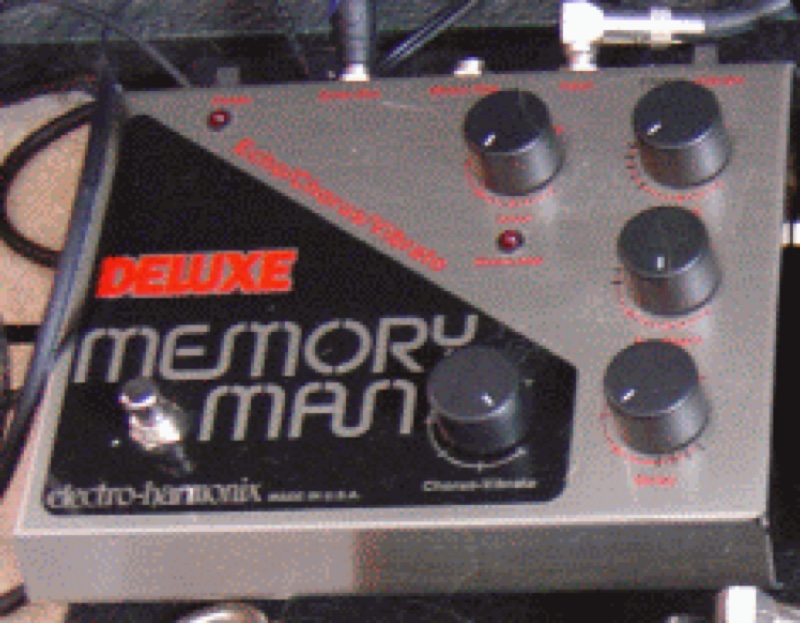
Electro-Harmonix · Deluxe Memory Man
Still the analog delay to beat, forty-plus years in.
The reason the company still matters. Analog delay built on bucket brigade chips, MN3005s in the originals, with a chorus and vibrato section that modulates the delay line itself instead of pasting wobble on top. I bought mine used in 2011 for $180 and it has outlived three boards and two amps. Set it around 300 milliseconds with the blend low and it does the wide, breathing repeat that every engineer I work with recognizes inside one bar. About $300 street for the current version, and nothing digital has retired it yet.
2 rebuttals filed
Electro-Harmonix · POG2
The most useful studio pedal EHX makes.
Two octaves up, one down, a detune, a low-pass filter, and an attack fader that swells notes in like a volume pedal you do not have to ride. It handles full chords without a hiccup because it never guesses at pitch the way monophonic trackers do. Blend the octaves, pull the attack back halfway, and you have a Hammond that fits in a backpack. I faked an organ part with a POG2 on a session in 2019 and the producer flew it through the entire song. About $310 street and worth it on the first invoice.
Electro-Harmonix · Freeze
The most original pedal of its decade.
A footswitch, a level knob, and a slow-fast-latch switch. Hold it down and the Freeze grabs a sliver of whatever you are playing and sustains it forever, so you can solo over your own chord or drone under a verse without a looper's bookkeeping. Nothing else did this when it landed in 2010 and almost nothing does it this simply now. Lo (lo.flannery) keeps one at the end of her chain and taps it under slide passages; the first time I heard it I thought she had hired a string section. About $130 street.
Electro-Harmonix · Ram's Head Big Muff Reissue
EHX undercut the entire industry cloning its own history.
The 1973 violet Ram's Head is the Muff on more famous records than any other version, and for years the only ways to own the sound were a boutique clone at $200 and up or an original at collector prices. In 2019 EHX reissued its own history in a nano box for about $120. It nails the woolly midrange and the singing sustain, it takes a booster in front exactly like the original, and it embarrassed a cottage industry overnight. Buying a clone of a pedal the original company sells for less is a hobby, not a decision.
Electro-Harmonix · Oceans 11
The reverb answer for people who refuse to spend $480.
Eleven reverbs for about $150 street. The Hall and the Plate are honest, the Spring beats pedals that only do spring, and the Shimmer clears the bar most $300 boxes trip on. There is a secondary function layer you will forget exists, and that does not matter, because the front panel gets you a working sound in ten seconds. This is the pedal I recommend to anyone who tells me they are saving up for something four times the price. Save the difference. Spend it on strings.
Column · The worst
The 5 I'd sell first.
Electro-Harmonix · Metal Muff
The name is honest. The top end is not.
The Metal Muff's gain character is fizz, the kind that sounds edgy on a couch and turns to static at band volume, and the Top Boost footswitch adds more of the exact frequency you were trying to escape. The three-band EQ is real and it still cannot rescue the core voice. Every practice space in America has one in the lost-and-found bin, which is the market publishing its review. About $95 street, and a used Boss HM-2 is the better bad idea.
Electro-Harmonix · Soul Food
A competent circuit wearing a myth three sizes too big.
The Soul Food was sold to the internet as the $100 Klon answer, and next to a good klone it is stiffer, brighter, and thinner, with a treble rise that no amount of knob work fully tames. The pedal is not a disaster. The discourse it created is: a generation now believes the Klon conversation got settled for a hundred bucks. It did not get settled. It got postponed. Buy the Soul Food as a bright boost and it is fine. Buy it as a Klon and you bought a rumor.
Electro-Harmonix · Synth9
Real synthesizer money for keyboard demo mode.
Nine synth presets with trademark-dodging names like Mini Mood and Profit V, and every one of them sounds like the demo mode on a keyboard you are walking past. Single notes track acceptably. Chords produce a warble no mix has ever asked for. I demoed one for twenty minutes at a shop in 2021, and the clerk and I agreed without saying a word to put it back on the wall. About $250 street, which is used MicroKorg money, and the MicroKorg will teach you where the notes actually live.
Electro-Harmonix · Big Muff Pi (NYC)
The worst Big Muff EHX sells, and the reissues read like a confession.
The current standard NYC Big Muff, about $85 street, is scooped so deep it vanishes the moment a bassist shows up. Alone in a bedroom it is enormous. On a stage it is a mime. The company spent the last decade reissuing the Triangle, the Ram's Head, and the Op-Amp so you could route around it, and that reissue program is the most honest product review EHX has ever published. Spend the extra thirty-odd dollars on any of the three and be heard.
Electro-Harmonix · Ravish Sitar
Nails the drone, misses the sitar.
The weird corner earns one seat on this list. The Ravish simulates a sitar with tunable sympathetic strings, and the drone half is genuinely beautiful, a shimmering cloud you can park under anything modal. The lead voice is the problem: a plastic quack that reads as sitar the way a rubber chicken reads as poultry. I bought one for a session in 2018, used it on one bridge, and sold it to the bass player before load-out. He sold it within the year too. About $250 street, while you can still find one.
Here is the scoreboard that matters. Fifty-eight years in, Electro-Harmonix still sells the best analog delay you can buy new, the most useful octave box ever made, and its own 1973 history for about $120, while shipping something unhinged every winter to see what sticks. The misses are not a scandal. They are the overhead. A company that never ships a Ravish Sitar never ships a Freeze either, so buy the Memory Man, the POG2, and the Freeze first, and treat the rest of the wall as a museum with a gift shop.
'Electro-Harmonix misses in public because it swings at everything. Buy the hits, dodge the fizz, and be glad somebody still swings.'
— Johnny
Discussion
Loading comments…